Market update – Sept & Oct 2022

Article written in October 2022

๐Ÿ’ก Zoom on US markets and VIX in Sept – Oct 2022 ๐Ÿ’ก

๐Ÿ“ˆ๐Ÿ“‰ 1. US markets: Ups and downs in line with recession expectations:

The US markets ($SPX500, $NSDQ100) are moving sharply up and down for the past four weeks, with no clear direction. The SP500 reached its lowest point below 3,500 on October 13th, when the September inflation data (CPI) at 8.2% was released, above expectations. The seasonal inflation was at 0.4%, higher than July and August (see Article 1).
However, the market quickly recovered, because well, the Fed had kept saying that they would continue the interest rates to bring inflation back to 2%, so inflation at 8% or 8.2% doesnโ€™t change much for the Fed’s next course of action.
The current earnings season is giving some information on how the US companies are weathering these difficult economic conditions – Microsoft ($MSFT (Microsoft)) and Google ($GOOG (Alphabet)) yesterday reported disappointing figures, highlighting the slowdown in sales while consumers and businesses around the world are cutting back on expenses (see Article 2).

๐Ÿ’ก 2. US markets: What does the VIX tell us?

One of the indicators I like to follow is the VIX ($VIX.FUT) as it illustrates the market expectations for the next 30 days. The VIX is intimately linked to the SP500 index, and usually, when the SP500 makes a steep move up or down, the VIX would react the opposite way, with a higher amplitude – it would move x3 or x5 the % of the Sp500 move.
However, in the past 4 weeks, it has occurred several times that the VIX actually moves less than the SP500 – example: the SP500 drops 2% and the VIX only increases by 1.5%. Or similarly, the SP500 gains 2% but the VIX only drops by 1%.
This tells us that the big actors in the market remain heavily hedged no matter what happens, and the market momentary swings, being 2% up or 2% down in a few hours, donโ€™t change expectations at allโ€ฆ
I would thus advise not to get carried on by sharp market moves, and stick to a long-term strategy.

๐ŸŽฏ 3. US markets – what to expect next? ๐ŸŽฏ

โœ… FOMC meeting on Nov 1st and 2nd, which may result in another rate hike
โœ… October CPI data to be released on Nov 10th

I hope this helps you understand what has happened in the past few weeks.

Thank you and trade safe!

Nico

Market update – August 2022

Article written in September 2022

๐Ÿ’ก Inflation and geopolitical tensions – August 2022 market drivers ๐Ÿ’ก

๐Ÿ“‰ 1. US markets: Determination of the Fed to bring inflation back down to 2%: ๐Ÿ“‰

The CPI (Consumer Price Index) data for July (revealed on August 10th) was positive, at 8.5% – lower than June data at 9.1%. Initially, the markets reacted very favourably. However, two weeks later, on August 26th, Powell made a speech in which he clearly stated that the tightening of the monetary policy (hikes in interest rates etc) would continue relentlessly (see Article 1 for more details).
Key quote: “[Back in the 1980s] A lengthy period of very restrictive monetary policy was ultimately needed to stem the high inflation and start the process of getting inflation down to the low and stable levels that were the norm until the spring of last year. Our aim is to avoid that outcome by acting with resolve now.”.
The US markets reacted very negatively to the speech and went down by almost 10% in the next days, before slightly going back up.

๐Ÿ“‰ 2. US and China: restrictions around sophisticated chips: ๐Ÿ“‰

End of August, the US government released a set of restrictions to the sale of high-end GPUs (Graphic Processing Units) to China and Russia, which affected severely Nvidia (threatening a business in China representing $400M in the last fiscal quarter) and aiming also at at least one of AMD chip. The news sent the overall semiconductor sector down (see ETFs SOXX, SMH, SOXL).
See Article 2 for more details.

๐Ÿ“ˆ 3. In Europe, the ECB rises interest rates by 0.75 points: ๐Ÿ“ˆ

The European Central Bank is also aiming to bring the inflation back down to 2%. After a first rate hike of 0.5% in July (the first increase in 11 years), on September 8th, the ECB increased interest rates further by 0.75%. At first sight, it looks like this determination to cool down inflation, setting recession fears aside, is pleasing the markets, as the Eurostoxx50 is up 2% at the time of writing.

๐ŸŽฏ 4. The Ukraine conflict evolves continuously: ๐ŸŽฏ

While it seems that the Ukraine war is set to last for a very long time, and there has been no major change in the situation on the field, the situation is actually evolving fast and this could impact the markets:
– Ukraine has launched a counterattack and is now leading initiatives on the battlefield
Russia has officially stopped supplying gas to Europe until “collective West” economic sanctions are lifted (see Article 4)
– For the first time in months, Russia also officially mentioned on September 5th (Russian presidential spokesman Dmitry Peskov) to be ready to negotiate the end of the war (see Article 5). While a resolution of the conflict seems still very unlikely to happen in the short term, as Moscow and Kyiv have currently very different views of what an agreement would look like, it’s an important sign that things are moving a lot under the surface

๐ŸŽฏ 5. What to expect next? ๐ŸŽฏ

โœ… Keep your eyes peeled for US CPI data on September 13th
โœ… FOMC meeting on September 20-21st
โœ… September is historically a bad month for stocks, so be careful; however, this year is quite unusual, so don’t make decisions solely based on historical data

Thank you and trade safe~

Nico

Market update – July 2022

Article written in August 2022

๐Ÿ’ก What drove the markets in July 2022? ๐Ÿ’ก

๐ŸŽฏ 1. US markets: inflation higher than expected and second 0.75% rate hike: ๐Ÿ“ˆ

Interestingly enough, while the scenario that played out in July is very similar to the one that played out in June – inflation at its highest point, “exceptional” interest rate hike of 0.75 point, etc – the markets have reacted very differently.

Inflation in June in the US peaked at 9.1% (CPI data released on July 13th), above expectations, and above May inflation at 8.5% (released in June). As a consequence, the Fed triggered a second 0.75 point hike for the US interest rates.

It’s tempting to think “nothing changed, actually it even got worse”. Yet, counterintuitively, the US markets have been going up from there until today (August 5th).

There can be two reasons for this:

a) In June, the markets were surprised and disappointed in May’s inflation reading (proving wrong the belief that inflation peaked in March), and feared a steep increase in the interest rates.
In July, the markets were expecting the inflation to be high, and expecting the rate hike to be high as well.

b) Markets are forward-looking.
And what happens after June’s inflation? July’s inflation, which should be quite lower because the energy prices have been going down. Hence, positive reaction from the markets.

๐ŸŽฏ 2. Oil is going down, what’s happening? ๐Ÿ“‰

$OIL is now trading below $90, tremendously lower than the peak above $120 that we witnessed in June.

What is driving this decline?

a) Demand is expected to be lower, because of:
– Recession fears
– China lockdowns
– Less activity after the summer

b) The US are getting closer to the OPEC:
The US have been continuously asking the OPEC to increase their oil output, and have approved this week the sale of weapons (THAAD missiles) to Saudi Arabia and the UAE for $5 billion. In exchange, the OPEC has committed to increase their oil output by 100,000 barrels per day. It’s not much (a 0.3% increase of the overall OPEC production), but it’s an important symbol.

The decrease in oil prices is positive news as far as inflation is concerned, and thus positive for the markets.

๐ŸŽฏ 3. What to expect next? ๐ŸŽฏ

โœ… CPI data for July will be released next Wednesday, on August 10th. If ever the inflation numbers are higher than July’s numbers, it should be quite negative for the markets; but most likely the number will be lower.

โœ… FOMC meeting minutes on Wednesday 17th August, which will let us know about the next rate hike.

โœ… Overall, stick to your strategy and to fundamentals, always learn and improve, and you will be fine!

Thank you and trade safe~

Nico

Market update – June 2022

Article written in June 2022

๐Ÿ’ก What drove the markets in June 2022? ๐Ÿ’ก

๐ŸŽฏ 1. US markets: inflation and rate hike higher than expected: ๐Ÿ“‰

Last Friday, 12th June, the CPI data (Consumer Price Index), used as a reference to track the inflation, came out worse than expected.
CPI was believed to have peaked in March 2022 at 8.5%, with April’s reading at 8.3% and forecasts for June around 8.3% as well. However, eventually, the CPI came out at 8.6%, which is thus a new peak.
This was not a good news, as it showed that inflation was still out of control, and the markets, especially $SPX500 and $NSDQ100 , went spiralling down immediately, losing 3% on Friday, and another 3% on Monday.

Markets were initially anticipating a 0.5% rate hike by the Fed in June, but after Friday’s CPI data release, markets dived in anticipation of a higher rate hike.
When the rate hike came at 0.75% on Wednesday 15th June (the highest rate hike by the Fed since 1994), the markets initially reacted with relief – certainty about the hike & comfort with the Fed trying to act decisively against inflation.
US interest rates are now at 1.5%.
Eventually, the “exceptional” rare hike of 0.75% and the possible subsequent ones is threatening to throw the US economy into a long-lasting recession – maybe it’s the price to pay to reduce drastically the demand and finally tame inflation.

Thus, US markets are now pricing in the possibility of a recession, and thus going down continuously.
Both SPX500 and NSDQ100 are now in bear market, more than 20% down from their ATH.

๐ŸŽฏ 2. European markets: ๐Ÿ“‰

The story is quite similar in Europe, where inflation is also at its highest point in decades. The ECB is being slightly less enthusiastic in rate hikes than the Fed for now, but the fears of tightening liquidity conditions is also making the markets go down.

The EUSTX50 is now also in bear market, more than 20% down from its ATH.

๐ŸŽฏ 3. China market: ๐Ÿ“ˆ

Interestingly, China is in very different economic conditions than Europe and the US, because:
– Demand is very slow, preventing prices from spiking up, due to Covid lockdowns etc
– The central bank, People’s Bank of China, is actually considering to lower interest rates to stimulate the economy rather than increasing them. China’s interest rates stand now at 2.85% (vs 1.5% in the US).

As a result, Chinese equities are somehow spared by the turmoil affecting the Western markets, and are even recovering from the previous lows caused by the lockdowns.

๐ŸŽฏ 4. Cryptos: ๐Ÿ“‰

Despite the hopes of many crypto supporters, overall the crypto market and BTC in particular have not proven yet to be “inflation hedges”.
Actually, it’s even quite the opposite: cryptos (led by $BTC ) remain closely correlated to the markets.

Furthermore, recent developments in the crypto world have been casting some doubts on the reliability of some actors and assets (Luna, Celsius etc).
The last two articles I enclose below provide more details on these two stories that have dramatically impacted the crypto world in the last weeks.

As a results, BTC is down 60% from its ATH, ETH is down more than 75% from it etc.

๐ŸŽฏ ๐—ช๐—ต๐—ฎ๐˜ ๐˜๐—ผ ๐—ฒ๐˜…๐—ฝ๐—ฒ๐—ฐ๐˜ ๐—ป๐—ฒ๐˜…๐˜? ๐ŸŽฏ

Eventually the markets will recover – good news will come from China regarding Covid, and good news will come from Europe regarding the war in Ukraine.
This will help the US as well in their fight against inflation, as the US economy is heavily connected to the rest of the world.
It’s not possible to guess when this will happen, and markets could go much further down before rebounding.

However, you should feel much more comfortable investing at these levels rather than at the ATH we had before (ex: SPX500 at a discount of 3,700 now vs 4,800 at ATH, NSDQ100 at 11,200 vs 16,800 at ATH, BTC at 20k instead of 60k, ETH at 1k instead of 4.5k etc) 

I hope this helps you understand a bit more what happened, and enjoy these days – it’s a great time to invest.

Thank you and trade safe!

Nico

China Market review – June 2022

Article written in June 2022

๐Ÿ’ก What’s happening on the Chinese markets? ๐Ÿ’ก

Over the past 3 months, $China50 has been stable (return: -0.5%) while the $SPX500 lost 4% and $NSDQ100 lost about 8%. Over the last 30 days, $China50 gained 7%, while $NSDQ100 and $SPX500 remained flat (eventually; although we did witness a lot of volatility in the last 30 days on the US markets).

๐ŸŽฏ Could this be the right time to invest in Chinese equities? ๐ŸŽฏ

1. Let’s recap the previous events that have affected the Chinese markets:

๐Ÿ“‰ a) The halt of Ant Group’s IPO and the start of the regulatory crackdown:

In October 2020, Ant Group’s IPO was suddenly halted, on the eve of the day it was supposed to happen. Alibaba ( $BABA (Alibaba) ) share price dropped sharply from its ATH above $300, as it was supposed to benefit from the IPO of one of its greatest affiliate companies.
Instead, this event marked the start of an intense campaign of regulation from the Chinese government and state institutions within China, aiming at controlling better the tech giants like Alibaba, Meituan, Tencent etc.

๐Ÿ“‰ b) Continuous Covid lockdowns:

China’s government is not willing yet to let go of the Zero Covid policy, as they have major concerns about the consequences an uncontrolled Covid spread could have on elderly populations that have not been vaccinated.
As a result, lockdowns have been paralyzing part of the country, including major cities like Shanghai, and threatening even Beijing.

๐Ÿ“ˆ c) The end of the regulatory pressure?

Mid-May 2022, Chinese officials have actually given positive signs of relief regarding the regulatory pressure on tech companies, in an effort to support the economy badly hurt by the Covid lockdowns (see Article 1).
The market went up on the news; to me, this wasn’t 100% a good news, as it meant that the Zero Covid policy would last a while longer. Yet, good to see the regulation effort calming down.

๐Ÿ“ˆ d) Lockdown reliefs:

Lockdowns actually helped to bring the number of Covid cases down, and now we are witnessing a significant relief in the restrictions in major cities like Shanghai and Beijing (see article 2).
This can have a positive effect on the economy, and could potentially help reduce inflation in western countries if the pressure on supply chains is being alleviated.

2. What could come next?

๐Ÿ“ˆ a) A greater cooperation between China and the US to counter inflation:

This could be a great news for the two biggest economies on the planet. To counter the rising inflation in the US, Biden is considering easing some of the tariffs imposed on China goods during Trump’s era (see article 3).

๐Ÿ“ˆ b) Towards an end of the Zero Covid policy?

Eventually, China will follow the rest of the world and relax Covid-related restrictions – it’s hard to tell when, but the government is well aware that restrictions are having serious adverse effects on the economy and people’s mental health.
When they will judge that letting Covid run would have less negative impact than imposing restrictions (because collective immunity would have increased, vaccination rate as well etc), the Covid chapter will be over.
At that point of time, Chinese equities will jump, as well as the rest of the world (positive effect on supply chain issues, inflation etc).


I hope this can help you make a decision about investing part of your portfolio into Chinese equities – check out the related ETFs like KWEB, CQQQ, YINN etc.
This article reflects my personal opinion and is not an investment advice.

Thank you and trade safe!

Nico

Sources:
Article 1: www.cnbc.com/2022/05/18/china-signals-easing-of-its-tech-crackdown-but-dont-expect-a-u-turn.html
Article 2: www.straitstimes.com/asia/east-asia/beijing-inches-closer-to-zero-covid-19-cases-as-curbs-eased
Article 3: www.cnbc.com/2022/05/10/inflation-biden-says-lowering-prices-is-his-top-economic-priority-.html

Zoom on the semiconductor industry

Article written in April 2022

๐ŸŽฏ Why should you consider investing in the semiconductor industry?

๐Ÿ’ก 1. Definition and context:

Semiconductors, or chips, are industrial products used in many products of our daily lives: computers, phones, cars, washing machines etc.
Players in the industry can focus on engineering and designing these products, like Nvidia Corporation or AMD, or solely manufacturing them, like TSMC, or both, like Intel.

There are several ETFs on eToro that let us invest in this industry, with the most famous being SOXX and SMH.
I personally also like to invest in the leveraged ETF SOXL that reproduces x3 the daily performance of SOXX.

Let’s see what kind of investment opportunity it is.

๐Ÿ’ก 2. Challenges ahead:

It’s no secret that the semiconductor supply chain has been encountering great issues since Covid started, because of different challenges at a manpower level (factories shitting down temporarily etc), as well as logistics (maritime transport disruptions, import/export rules), and supply of raw materials.

While these points are actually likely to see drastic improvements in 2022, the greater risk for the semiconductor industry is actually a geopolitical risk.

Semiconductors, chips and their innovations are so important for our near future that governments are watching closely the companies involved in the sector, and could decide to take actions that may disrupt further the industry.
For instance, TSM (Taiwan Semiconductor Manufacturing Co Ltd) is one of the most important players in the industry, and it’s located in an area subject to territorial disputes. Any conflict between Taiwan and China would pose a serious threat to the stability of the semiconductor market.

๐Ÿ’ก 3. Opportunities:

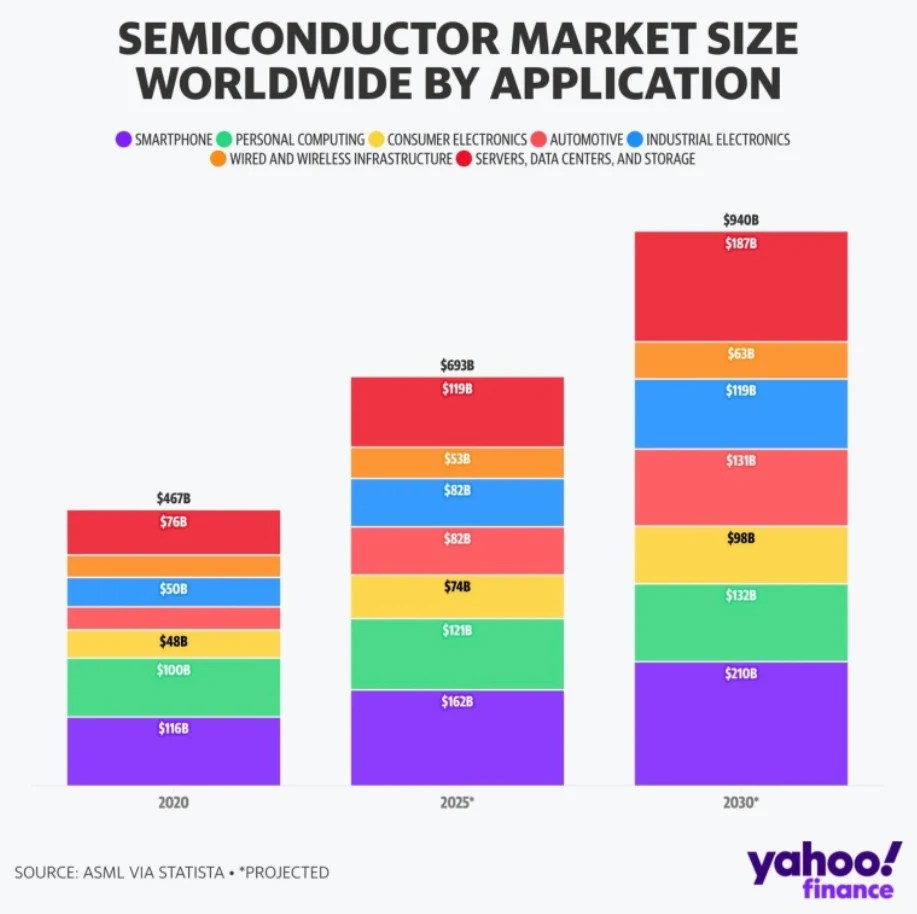
That being said, despite the possible obstacles on the way, the semiconductor industry is going to experience a phenomenal expansion in the next years.
Indeed, semiconductors are components of the items we use the most, and that we increasingly rely on: smartphones, computers, servers and data centers etc.
Thus, the semiconductor market is expected to double in size from 2020 to 2030 (see chart enclosed).
Furthermore, some key companies in the ETFs mentioned above, like Nvidia, are likely to experience even more growth by taking part into related applications like the Metaverse (see the Fool.com article enclosed at the bottom).

๐Ÿ’ก 4. Conclusion:

If you take a long-term vision (years and not months), there is a great chance you will be rewarded by investing in the semiconductor industry, as the use our society makes of it will only increase. If you are not comfortable picking specific stocks, investing in related ETFs are the best way to start.

Thank you and trade safe!

Nico

Sources:
Investopedia
Fool.com

Inflation in 2022

Article written in April 2022

๐ŸŽฏ Why will inflation play a key role for investors in 2022?

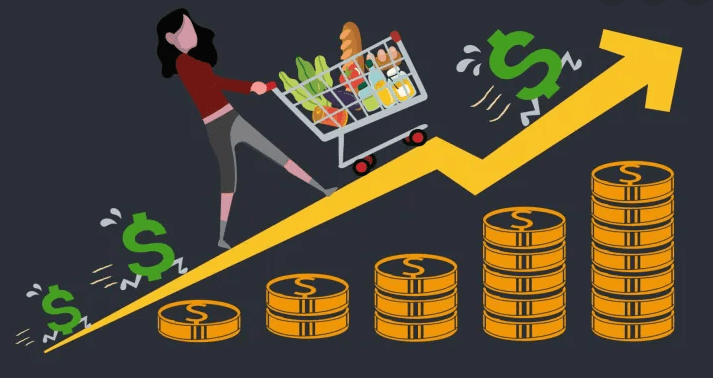
๐Ÿ’ก 1. What is inflation? Definition and a bit of history:

If you search for “inflation” on Google, the first definition you can find is “a general increase in prices and fall in the purchasing value of money”.
The simplest consequence to understand is that if you have $100 today, and if there is inflation, in the future, you will not be able to purchase as much as you can today with these $100.

Inflation is not necessarily a bad thing. Actually, historically, inflation has always been there, and it’s something to be aware of.
Example: If you had $100 in 1950, these would be worth $1,200 today, 12 times more. So what you could buy with $100 in 1950, you now need to fork out $1,200 to get it.
Example 2: If you had $100 in 2000, 22 years later in 2022, these $100 would be worth $166.

Thus, inflation is a constant in our economy and the recent history. Governments and central banks monitor the inflation rate and always try to keep it under control.
If they fail to do so, a phenomenon of hyperinflation can occur, where the currency loses its value exponentially. This has happened many times to many countries (ex: Germany in the 1920s, Zimbabwe in the 2000s, in the 2010s etc). Eventually, people find other ways to purchase than paying with the currency undergoing hyperinflation.

That being said, a moderate inflation is very common, and the inflation for the USD since 1950 has been at 3.5% per year on average.
Which means that at the start of the 1st year in 1950, a product costing $100 will cost $103.5 at the start of the second year in 1951, and then $103.5 * 1.035 = $107.12 at the start of 1952 etc.

๐Ÿ’ก 2. What can lead to a high inflation, and why is it happening in 2022?

Inflation is driven by several factors.

The easiest to understand is “money-printing”, when governments give out financial help and subsidies to companies or citizens, or when central banks purchase more assets like company debts etc – like it happened during the Covid crisis.

Another driver of inflation is an increasing scarcity of a product or resource. This is a major driver in 2022, mostly because of the war in Ukraine. The conflict hurts directly the capacity of production of both Ukraine and Russia for many resources (cereals, fertilizers etc), but also triggered economical sanctions on Russia’s exportations (oil and gas), driving the cost of energy higher, and thus increasing the costs of production across many industries.

As we can see, while historically, a moderate inflation is very common, the current macroeconomic context in 2022 (Covid crisis with huge financial support from governments and central banks, as well as Ukraine conflict) is very favorable to a higher inflation. And as a matter of fact, the first three months of 2022 have seen an inflation above 5%, with the Consumer Price Index rising by 8.5% in March 2022 – the highest inflation rate we saw in decades, since 1981.

๐Ÿ’ก 3. Why should investors pay attention to inflation in 2022?

We have seen that inflation in 2022 is abnormally high – 8.5% in the US in March while the yearly average since 1950 is at 3.5%. This has two major consequences for investors.

The first consequence is that it’s more important than ever to invest your savings rather than keeping them idle. Indeed, idle money is depreciating at a very high pace: $100 that you had in March 2021 are only worth $92 today (March 2022).
However, if you had invested this money in simple assets, like an ETF tracking the SP500, or an ETF tracking the price of Gold, you would have benefited from a return on investment of more than 10% between March 2021 and March 2022, thus counterbalancing the 8.5% of inflation and even getting a net benefit of roughly 1.5%.

The second consequence is that if you are already invested in different assets (stock market, commodities etc), inflation will definitely reshuffle the cards, and winning assets tomorrow won’t be the same as today.
Indeed, inflation increases the cost of energy, raw materials, etc and some companies will benefit from it (ex: oil and gas producers) while some will lose out (manufacturers, transport etc).
Simultaneously, inflation will force central banks and governments to take measures to control it (ex: reducing the purchase of company debt, interest rate hikes etc), so borrowing money will be more costly. It may be a concern for companies that are not profitable yet, and need extra capital to pursue their growth (ex: innovative companies). On the other hand, some sectors are known to do well when inflation is high, like real estate or the banking industry.

Investors should then carefully consider if they need to rebalance their portfolio. In this page, I am sharing about my own portfolio strategy in 2022 to cope with a high inflation.

Thank you for reading and trade safe!

Nico

Source: in2013dollar.com

Stock Market Historical Returns

Article written in April 2022

๐ŸŽฏ Is investing in the stock market really profitable?

๐Ÿ’ก Context:

I hear people saying that investing in the stock market is the best way to make money; at the same time, I also hear people saying that it’s like gambling, and the risk of losing part of, or even all your investment, is not worth trying.

Thus, let’s look at facts. For this article, I will talk about the SP500 index, as it is commonly used as benchmark to evaluate the performance of an investment portfolio.

The SP500 index (short for Standard & Poor’s 500 Index) is composed by 500 US-listed companies, and it has been this way since 1957. The companies in that index are chosen by the S&P 500 Index Committee, who select them based on market size, liquidity and group representation. This ensures that the SP500 index represents fairly well the US economy, and this is the reason why the index’s performance is commonly used to benchmark investment returns.

๐Ÿ’ก SP500 historical returns:

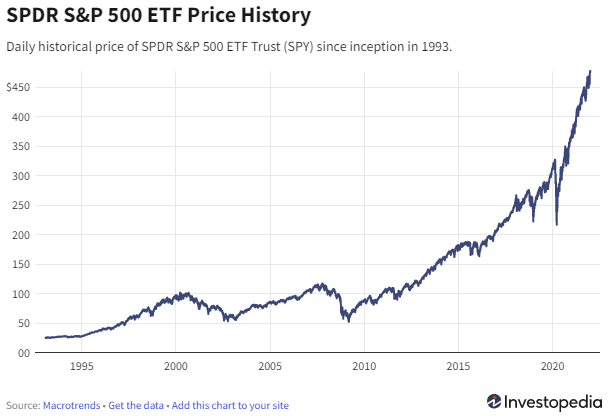
Since 1957, the average annual return of the SP500 index is 10.67%.
Since 1972 (50 years ago), it’s even higher: the average annual return is at 11.17%.

This means that if you had invested $10,000 in 1957 and got the same returns, your investment would now be worth more than $650 million.

Such a consistent performance means that yes, investing in the stock market is really profitable on the long term.

๐Ÿ’ก To keep in mind:

The historical performance of the SP500 index is truly impressive.
However, only taking a long-term perspective, not even in years but in decades, enable to achieve such returns.
On a yearly basis, your return on investment may very well be negative (in case of an ecomonic crisis etc).

Actually, if you look at the SP500 annual return chart, you can see that most of the years actually have double digit returns – positive or negative. The journey is not smooth.
Thus, you should only invest money that you will not need in the near future (3 to 4 years from now).

Thank you and trade safe!

Nico

Source: Investopedia

The Power of Buying and Holding – Part 2

Example: Bitcoin.
Article written in April 2021 and [edited] in February 2022.

In this article, I want to highlight why patience is key to generate significant wealth by investing.

๐Ÿ’ก Would you be rich if you invested $1,000 in Bitcoin (BTC) 10 years ago, in April 2011?

Setting up a bit of context.
About 10 years ago, in April 2011, one Bitcoin was worth $1.
Today [in April 2021], one Bitcoin is worth about $60,000.
So, if you invested $1,000 in April 2011, today [in April 2021] you would have $60 millions worth of it.

So Nico, it’s obvious, if only I had invested in Bitcoin 10 years ago, I would be rich!

Is it though?

The truth is, most people would never realize such a massive profit. Why?

Simply because people are not patient enough to wait until their assets reveal their true potential.
โŒ If your target was x2, you would have sold too early.
โŒ If your target was x10, you would have sold too early.
โŒ If your target was x100, you would have sold too early.
โŒ If your target was x1000, you would have sold too early.
โŒ If you were afraid of pullbacks, you would have left the boat countless times. After all, Bitcoin keeps on going up and crashing, going up and crashing.

๐Ÿ’ก Oh… So, how to become rich with investing?

โœ”๏ธ Invest in assets with strong growth potential, and hold them beyond the daily / weekly / monthly turbulences. Aim for years of holding.

โœ”๏ธ Invest more during red days, because the biggest profit opportunities come up during red days.

โœ”๏ธ Aim to grow your portfolio, not only by profit and compound interest, but also by adding funds regularly (at least every month).

Please note that I used the example of Bitcoin in this article because of its spectacular growth in the past ten years, but other assets work the same way.
Ex: Amazon stock was trading at $1.5 at the IPO in 1997, and now trades around $3,000, which is 2,000 times the initial price.

I hope you will find these ideas useful.

Thank you and trade safe!

Nico

Crypto valuation

Article written in May 2021 and updated in February 2022

๐Ÿ’ก ๐—ช๐—ต๐—ฎ๐˜ ๐—บ๐—ฎ๐—ธ๐—ฒ๐˜€ ๐˜๐—ต๐—ฒ ๐—ฐ๐˜‚๐—ฟ๐—ฟ๐—ฒ๐—ป๐˜ ๐˜ƒ๐—ฎ๐—น๐˜‚๐—ฎ๐˜๐—ถ๐—ผ๐—ป ๐—ผ๐—ณ ๐—ฐ๐—ฟ๐˜†๐—ฝ๐˜๐—ผ๐˜€? ๐Ÿ’ก

Cryptos valuation has grown considerably in the past months, and people believe cryptos still have a lot of growth potential. However, these assets have also lost a fair bit of value in the past weeks, and if you started investing early May 2021, you could be quite worried already.

Here are the 2 main drivers of crypto valuation these days:

๐ŸŽฏ ๐Ÿญ. ๐—ฃ๐—ฒ๐—ผ๐—ฝ๐—น๐—ฒ ๐˜„๐—ฎ๐—ป๐˜ ๐—บ๐—ผ๐—ป๐—ฒ๐˜† ๐—ฒ๐—ฎ๐˜€๐—ถ๐—น๐˜† ๐—ฎ๐—ป๐—ฑ ๐—ณ๐—ฎ๐˜€๐˜:

a) Major cryptos, Bitcoin ahead, have gone up tremendously since their inception (10 years ago, 1 BTC = US$ 1โ€ฆ) This kind of figures make people dream.
We think: “If I can find the next Bitcoin and invest in it, I can be a millionaire easily.”

b) This rationale has driven up the prices of altcoins rather than Bitcoin in the past months.
We think: “Bitcoin maximum upside is x10 or maybe x20, it’s not enough, I can get x100 or x1000 with an altcoin.”
This greed has also driven up the price of assets like Doge coin, which doesnโ€™t have much use besides its potential future $ value.

c) There is no tax on profits made by trading cryptos, which increase the upside of it.

๐ŸŽฏ ๐Ÿฎ. ๐—™๐˜‚๐˜๐˜‚๐—ฟ๐—ฒ ๐—ฝ๐—ผ๐˜๐—ฒ๐—ป๐˜๐—ถ๐—ฎ๐—น ๐˜ƒ๐—ฎ๐—น๐˜‚๐—ฒ ๐—ฎ๐—ป๐—ฑ ๐˜‚๐˜€๐—ฒ:

This is a very interesting point. Cryptos and more generally blockchain have the potential to disrupt tremendously how we do things in many areas.

However, I rank this driver second and not first, because of:

a) The hype around Doge coin and other altcoins, which shows an investment pattern towards quick profit rather than actual product value

b) The recent 40-50% crash in a few hours (on May 19th). No asset hovering around its fair value would lose 50% in a few hours.

c) There is a consensus that Bitcoin has less potential use than other cryptos like Ethereum, Ada. However, Bitcoin is still far ahead in terms of market capitalization, not reflecting the actual potential of each crypto.

๐Ÿ’ก ๐—ฆ๐—ผ ๐˜„๐—ต๐—ฎ๐˜ ๐—ฑ๐—ผ๐—ฒ๐˜€ ๐˜๐—ต๐—ฎ๐˜ ๐—บ๐—ฒ๐—ฎ๐—ป? ๐Ÿ’ก

1. People sentiment towards cryptos is holding up their current valuation.
The likely emergence of regulations in Europe or in the US could shift that sentiment, and the bubble would then burst.

2. Investing now in cryptos is very risky, but could still be very rewarding.
The proper way to invest in a cryptocurrency today is to do your own research about its potential use and the projects behind it, as you would do it for a company.
You should also keep reassessing your investment decision every quarter, as new projects and applications could come up, or some projects could be given up on.

I hope this can help you guys make relevant decisions!

Nico