Article written in April 2022
🎯 Why will inflation play a key role for investors in 2022?
💡 1. What is inflation? Definition and a bit of history:
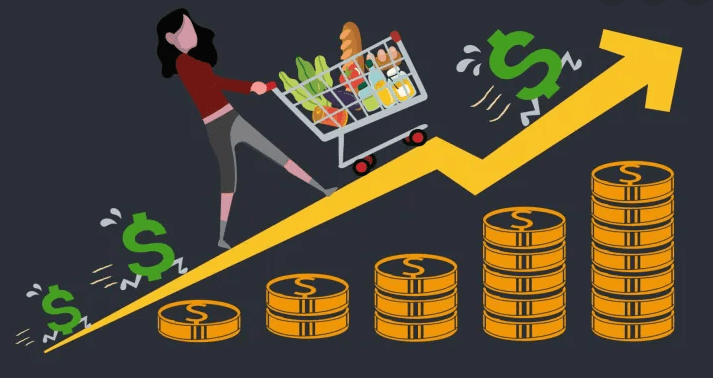
If you search for “inflation” on Google, the first definition you can find is “a general increase in prices and fall in the purchasing value of money”.
The simplest consequence to understand is that if you have $100 today, and if there is inflation, in the future, you will not be able to purchase as much as you can today with these $100.
Inflation is not necessarily a bad thing. Actually, historically, inflation has always been there, and it’s something to be aware of.
Example: If you had $100 in 1950, these would be worth $1,200 today, 12 times more. So what you could buy with $100 in 1950, you now need to fork out $1,200 to get it.
Example 2: If you had $100 in 2000, 22 years later in 2022, these $100 would be worth $166.
Thus, inflation is a constant in our economy and the recent history. Governments and central banks monitor the inflation rate and always try to keep it under control.
If they fail to do so, a phenomenon of hyperinflation can occur, where the currency loses its value exponentially. This has happened many times to many countries (ex: Germany in the 1920s, Zimbabwe in the 2000s, in the 2010s etc). Eventually, people find other ways to purchase than paying with the currency undergoing hyperinflation.
That being said, a moderate inflation is very common, and the inflation for the USD since 1950 has been at 3.5% per year on average.
Which means that at the start of the 1st year in 1950, a product costing $100 will cost $103.5 at the start of the second year in 1951, and then $103.5 * 1.035 = $107.12 at the start of 1952 etc.
💡 2. What can lead to a high inflation, and why is it happening in 2022?
Inflation is driven by several factors.
The easiest to understand is “money-printing”, when governments give out financial help and subsidies to companies or citizens, or when central banks purchase more assets like company debts etc – like it happened during the Covid crisis.
Another driver of inflation is an increasing scarcity of a product or resource. This is a major driver in 2022, mostly because of the war in Ukraine. The conflict hurts directly the capacity of production of both Ukraine and Russia for many resources (cereals, fertilizers etc), but also triggered economical sanctions on Russia’s exportations (oil and gas), driving the cost of energy higher, and thus increasing the costs of production across many industries.
As we can see, while historically, a moderate inflation is very common, the current macroeconomic context in 2022 (Covid crisis with huge financial support from governments and central banks, as well as Ukraine conflict) is very favorable to a higher inflation. And as a matter of fact, the first three months of 2022 have seen an inflation above 5%, with the Consumer Price Index rising by 8.5% in March 2022 – the highest inflation rate we saw in decades, since 1981.
💡 3. Why should investors pay attention to inflation in 2022?
We have seen that inflation in 2022 is abnormally high – 8.5% in the US in March while the yearly average since 1950 is at 3.5%. This has two major consequences for investors.
The first consequence is that it’s more important than ever to invest your savings rather than keeping them idle. Indeed, idle money is depreciating at a very high pace: $100 that you had in March 2021 are only worth $92 today (March 2022).
However, if you had invested this money in simple assets, like an ETF tracking the SP500, or an ETF tracking the price of Gold, you would have benefited from a return on investment of more than 10% between March 2021 and March 2022, thus counterbalancing the 8.5% of inflation and even getting a net benefit of roughly 1.5%.
The second consequence is that if you are already invested in different assets (stock market, commodities etc), inflation will definitely reshuffle the cards, and winning assets tomorrow won’t be the same as today.
Indeed, inflation increases the cost of energy, raw materials, etc and some companies will benefit from it (ex: oil and gas producers) while some will lose out (manufacturers, transport etc).
Simultaneously, inflation will force central banks and governments to take measures to control it (ex: reducing the purchase of company debt, interest rate hikes etc), so borrowing money will be more costly. It may be a concern for companies that are not profitable yet, and need extra capital to pursue their growth (ex: innovative companies). On the other hand, some sectors are known to do well when inflation is high, like real estate or the banking industry.
Investors should then carefully consider if they need to rebalance their portfolio. In this page, I am sharing about my own portfolio strategy in 2022 to cope with a high inflation.
Thank you for reading and trade safe!
Nico
Source: in2013dollar.com
 Cheetah26 (Nicolas Oddo) - eToro Popular Investor